
Bryan Boyd, Secretary of the Victorian Trades Hall Council (VTHC), has a Soapbox
column on the council’s webpage. In June, Boyd said the debate about industrial relations
is “hotting up in 2008 as the federal government develops its ‘substantive’ IR bill – the
draft to be available in the second half of the year.”
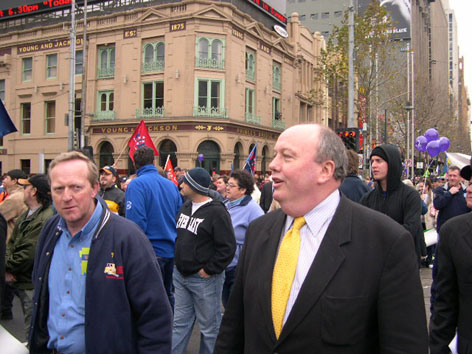
Bryan Boyd marches in the 30 June 2005 mass protest.
Boyd characterises the current debate as “employer associations, pushing back hard
against the election promises in 2007.” WorkChoices in particular and Howard’s IR
legacy in general will, he says, be “ripped up” and “put in the rubbish bin.”
He also quotes former Liberal MP Michael Baume, describing his comments as
“perceptive.” In an opinion piece in the Financial Review, Baume, a conservative
commentator who clearly understands that government cannot serve the interests of
both the ruling class and the working class, writes: “if the end of WorkChoices and the
replacement of the…Australian Building and Construction Commission only means
changes that are more cosmetic than substantive the union movement is unlikely to
accept it without a fight.” Let’s make sure he is right!
Boyd responds, “the Your Rights @ Work campaign has to go up a few more notches.
There is a lot at stake and a lot to lose.”
Let’s ratchet up the pressure! Boyd is right. The campaign urgently needs to be
escalated and there is widespread support for what he says. The task now is to make it
happen!
On May Day, a group of rank-and-file unionists and workplace delegates launched an
open letter to the Victorian Trades Hall Council Executive. The letter recognised that
the Victorian Trades Hall Council has “played a key role in organising mass union
and community protests against WorkChoices” and the signatories asserted that “mass
union-led action is urgently required to win the full eradication of WorkChoices and
to guarantee workers the complete freedom to organise.” In the space of a week it
attracted 200 signatories from workers belonging to trade unions as diverse as the Shop
Distributive and Allied Industries Association to the Maritime Union of Australia.
Signatories pledged to campaign for complete abolition of individual agreements and
“the unfettered right to collective bargaining, including the right to pattern bargaining
on an industry-wide basis, immediate abolition of the repressive Australian Building and
Construction Commission and opposition to the proposed establishment of a replacement
body to take over its functions, the enactment of unfair dismissal legislation with teeth
which covers all workers, guaranteed right of entry of union officials to workplaces,
including those that are not yet organised, and for complete freedom of workers to
take strike action around any issue, industrial or political.” They further called on the
Victorian Trades Hall Council “both to organise a campaign of mass industrial and
protest action in support of these goals and to urge the Australian Council of Trade
Unions to support the Victorian campaign.”
While many union officials continue to peddle the idea that everything is going to
plan and that we just need to wait until 2010 for the government’s “substantive bill,”
grassroots unionists hold no such illusions and want to fight now.
What are we waiting for? Deputy Prime Minister Julia Gillard revealed the Rudd
government’s true agenda last January. Gillard decreed that industry-wide strikes would
remain “unlawful” and threatened that “under Labor’s laws the courts will come down
like a tonne of bricks on anyone engaged in illegal industrial activity.”
Coming into force on March 28, Rudd’s Workplace Relations Amendment Bill of 2008
leaves most of Howard’s WorkChoices legislation intact. The Rudd government’s broad
approach to industrial relations is based on a general philosophy of individual rights,
rather than an approach based on union rights.
The transition law allows employers four months to impose AWAs on their workforces,
because it was not backdated. Tens of thousands of employees face another five years
on inferior conditions and low wages. It also allows employers who have AWAs in
place to use a form of individual agreement called an Interim Transitional Employment
Agreement (ITEA). These AWA clones can be offered until the start of the new industrial
relations system in 2010. All existing AWAs also remain in place and can even run past
their end date! Workers forced into these agreements do not have the right to opt out of
their agreement and be covered by a collective agreement or an award.
The Rudd government has only mandated 10 very basic minimum employment standards
and asks the Australian Industrial Relations Commission to “modernise” and “simplify”
all current industry Awards. Flexibility clauses in awards and agreements will allow
bosses to roll over many conditions into annualised salaries. What Howard achieved
through individual agreements, Rudd is doing under the guise of allowing flexibility.
The Rudd government has no plans to give workers the right to strike, except in a
bargaining period after an agreement has expired, and only after a state-run secret ballot.
Any worker who takes unauthorised industrial action will face fines of up to $6,600, just
as they did under Howard. Unions are still threatened with large fines if they don’t stick
to the rules.
The government also plans to maintain the Australian Building and Construction
Commission (ABCC.) It is armed with extraordinary powers that allow it to prosecute
unions and intimidate and fine workers for allegedly illegal industrial action.
Not surprisingly many employer groups are quite happy with Rudd’s IR laws. Australian
Industry Group chief executive, Heather Ridout, said the bill was “balanced and workable
for business.” Bosses know that in an economic downturn Labor governments are much
better placed to suffocate struggle through their cosy relationship with the trade union
bureaucracy, which plays a key role in keeping worker militancy in check.
Wake up and learn from history! It is clear that the Australian Council of Trade Unions
will not lead the fightback that the union movement needs. It adopted a “strategic plan”
at its March executive meeting, declaring that it wants to “play a positive role in the
wider economic debate” to achieve what is “good for workers and good for the Australian
economy.”
Workers must not buy into arguments about the need to be “economically responsible.”
We have heard it all before — and we have lived through the consequences! The Hawke
Labor government initiated 13 years of wage restraint on workers. Under the Prices and
Incomes Accord, workers were to get health, education, transport, and childcare in return
for foregoing wage increases. The neoliberal economic agenda killed off this “social
wage” before it took root. During the Accord years, real wages fell by 17 – 28% and
unionism fell from 51% to 31% as profits skyrocketed.
When Bryan Boyd looks at the comments of Michael Baume, a representative of the
ruling class, he sees a commentator with clarity, organising in the interests of his class.
Working class people must do likewise or continue to see our standard of living fall
while profits balloon. It is time for Bryan Boyd and the Trades Hall Council Executive to
provide the actual lead they write about on their webpage — out of cyberspace and into
the streets!






