
If your lounge room, local pub or union office was as ecstatic as mine, then you probably
heard nothing more of John Howard’s concession speech after “I telephoned Mr Kevin
Rudd and I congratulated him…” It was a moment to enjoy — 9.32 pm, 24 November
2007, the end of the most reactionary government this country has ever seen. And the
news kept getting better. Mal Brough, the minister for Indigenous land theft — gone!
Arch-reactionary National party hack, Dee-Ann Kelly — gone!
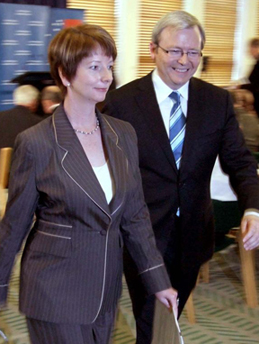
Julia Gillard and Kevin Rudd. From abc.net.au.
Ah but then there was the rambling, pro-business, “govern for all Australians” victory
speech by Prime Minister-elect Kevin Rudd. Many squirmed, some, like the gathering I
attended, hissed and jeered. Still, we knew that was going to happen. Eventually, Rudd
ran out of clichés and the ABC returned to the results. Rudd was temporarily forgotten
because, well, surely it couldn’t get that good? John Howard, member for Bennelong —
beaten by Maxine McKew? Then, next morning, former treasurer, Peter Costello, tossed
in the towel.
We had to wait over a week before McKew was confirmed as the Howard’s replacement.
Still, as a blood sport, it was an enjoyable weekend for the millions who wanted to watch
the death throes of Howard’s regime.
Monday came with a question. Politically, what did the election of a Rudd government
mean to the working class? What would change in 2008? People were pleased and
relieved to see the end of Howard, but very wary and cynical about Rudd and the
Australian Labor Party (ALP). Workers are hopeful that policies will change, but there is
no confidence that Rudd will break from Howard in any substantial fashion.
Howard’s loss not Rudd’s win. This election was not a victory for the ALP. The new
government owes its position to widespread anger and disgust aimed directly at Howard.
The Australian electorate saw his Coalition government as arrogant and were livid about
WorkChoices. The November rise in interest rates was probably the last nail in the coffin
as far as Howard’s “economic credibility” was concerned, particularly as he had earlier
told the electorate that working families had never had it so good. This lie, added to
the GST we were “never ever” supposed to have, children overboard and weapons of
mass destruction, was more than enough for struggling workers. Added to this were the
demonisation of unionists and the open use of racism as a tool to divide the community.
Months before the election, people had made up their mind: the Howard government had
to be defeated. Perhaps 90 percent of the swing to the ALP consisted of the anti-Howard
sentiment, which political commentators called the “it’s time” factor.
Where the vote was for the Rudd opposition, it was probably due to the one major policy
difference — climate change. There is a very broad concern about the environment,
partly because of the worst drought since white settlement and partly because of climate
change in general. The electorate wanted action. Howard responded with more weasel
words. Rudd promised to ratify the Kyoto Protocol and to join international negotiations
about its replacement. This led the Greens to direct preferences his way, handing the
ALP the marginal seats it needed to form government. But here, again, Rudd is not to
be trusted. Sure, he did sign on to the Kyoto accords. Yet his pro-business bias means
that conserving the environment will run a poor second to conserving profits. The ALP’s
support for Gunns’ Launceston pulp mill and the dredging of Port Phillip Bay is proof of
that.
Working class consciousness awakes. For the first time in many elections, there was
a clear emergence of class as an election issue. This was almost entirely because of
WorkChoices, which attacked workers’ economic security.
During the 2004 election campaign, the plan to cut the pay and trash the conditions of
Australian workers was kept hidden from voters. When it became clear that Howard
had control of the Senate, the already-prepared industrial laws, cynically dubbed
“WorkChoices,” were sprung on the electorate. This was the dirty trick that marked the
beginning of the end for the Coalition. The deception was hated enough, but the naked
pro-employer bias and the vicious union-busting character of WorkChoices shocked and
enraged workers, and not only union members.
Howard gambled that the declining number of union members was matched by a fall
in support for the principle of unionism itself. That was his biggest mistake. The union
movement launched Your Rights at Work (YRAW), a campaign that became both a mass
mobilisation and the most successful non-commercial PR campaign the country has seen.
In the end, the government abandoned the name “WorkChoices” in its propaganda. On
the upside, YRAW, for the first time in decades, put the clear class question of trade
unionism before the electorate. The downside is that the pro-ALP hierarchy of the union
movement sabotaged the highly successful stopwork actions and mass demonstrations
that characterised the first stage of YRAW.
Minor parties marginalised. The Socialist Alliance ran candidates in both the lower
house and the Senate. Its share of first preference votes continues to decline as the
sectarian takeover of the party by the Democratic Socialist Perspective (DSP) nears
completion. This represents a real setback for socialist electoral politics in general. The
DSP has succeeded in marginalising socialism as an alternative voice at election time.
It should be at front and centre. The Socialist Party’s candidate in the seat of Melbourne
fared little better, although unfair electoral laws prevented her from using her party’s
name on the ballot paper.
It wasn’t all bad news: the Nationals, junior partner in Howard’s former government, can
claim support from only one in 20 voters and looks doomed. The Democrats are history.
They had zero impact on the election campaign, as their decision to support the Goods
and Services Tax two elections ago saw their remaining senators tossed out. The religious
Right must be disappointed. While Fred Nile’s Christian Democrats gained a couple of
thousand votes, Family First went nowhere. It’s clear that their senator only holds his
seat courtesy of the ALP’s 2004 preference decisions. The various fragments of One
Nation went backwards, although Pauline Hanson squeezed past 4% and gained another
$200,000 of taxpayers’ funds to continue her career of xenophobic hate-mongering.
The Greens win third prize. The Greens won just over 2.1 million first preference
votes. This is a 20% increase compared to 2004. With just over 11% of the aggregate
lower house/Senate vote, the party’s electoral star is still rising, but it relies heavily on
inner city pro-environment voters, although some trade unionists undoubtedly voted for
them as well. The Greens ran a fairly broad campaign, running hard on total opposition
to WorkChoices. For the first time, some unions supported The Greens over Labor as a
protest against Rudd’s “WorkChoices Lite” policies. Yet on election night their leader,
Bob Brown, sounded like a single-issue environmentalist.
Brown reflects divisions within the party. Increasingly, The Greens is split between
the “deep” greens — more or less single-issue environmentalists — and the “red”
greens, who are for broader social change. A section of the party bureaucracy sees it as
a parliamentary “balance of power” party, like the Democrats. This notion is opposed by
a large part of the party membership, which wants it to be an activist organisation. As an
activist organisation, The Greens may have a broader political influence. The fate of the
Democrats, who made one dirty deal too many with the government, is a clear warning of
the party’s fate, should The Greens attempt to take the same course.
As Rudd’s government loses its gloss, The Greens stand to gain more disaffected ALP
voters. This will make some inner city seats marginal for the ALP, because the Greens
could get very close on preferences. The seat of Melbourne, for example, used to be a
safe ALP seat. It is now a marginal seat, with The Greens needing a swing of just under
5% to take from Labor a constituency it has held since 1904.
The problem with The Greens is that it is not an anti-capitalist party. That makes
it a fundamental obstacle to genuine political change. The source of environmental
degradation and social injustice is the dominant economic system. Attempts to fabricate a
gentler, sustainable capitalism are as useful as shifting the deckchairs on the Titanic. The
Greens’ failure to ditch support for the profit system means that the thousands of well-
intentioned activists who have joined the party are wasting their efforts. As things stand
today, The Greens is more a part of the problem than the solution.
Battles still ahead of us. The ALP fought a “me, too” election campaign, backing almost
all of the policies announced by Howard over the past year. From the land grab in the
Northern Territory, to same-sex relationships, attacks on civil liberties and the “war on
terror,” Rudd speaks the same language as Howard did. The fact is that all of the major
fights begun under Howard are still to be won under Rudd.
The ALP’s support for the wars in Afghanistan and Iraq place it firmly in the camp
of U.S. imperialism. “Troops out of Afghanistan and Iraq,” is still a demand we need
to raise on the streets. And, of course, Rudd stands in a long line of ALP leaders who
championed Australian imperialism in its own right. The “Troops out” demand needs to
include East Timor and the Solomon Islands.
And let’s not forget the invasion of Indigenous country in the Northern Territory. An
apology to the Stolen Generations is an insult if the Rudd administration persists in the
genocidal land grab. This is particularly true now that we know, courtesy of former
Foreign Minister Alexander Downer, that the “intervention” was not about child welfare.
It was just a failed tactic designed to win the last election. “Treaty, yes, Troops out now!”
There’s a banner that will see some use in coming months!
Apart from our rights as unionists, there is an urgent need to force the new government
to repeal the anti-terror laws, which are aimed much less at al Qaeda than at destroying
our fundamental civil liberties. All these laws must be repealed. As we saw so clearly
in the case of Dr Mohamed Haneef, who was deported back to India on trumped up
“suspicion,” the laws are an invitation to the police: “if there’s no evidence, make it
up.” That also means that all charges laid under the legislation must be dropped and the
victims compensated for their false imprisonment.
The list is long. Same-sex couples must have the same rights as other citizens. That
means forcing Labor to reverse the amendment to the Marriage Act it so cravenly
supported as Howard attempted another divisive “wedge” manoeuvre. People on social
security payments deserve support, a living income and an end to punitive fines. That
means repealing Welfare to Work and reversing decades of government bullying of the
poorest in Australian society. The internment of refugees, a policy devised by the Keating
government 16 years ago, must end. People fleeing persecution and poverty should be
welcomed into Australian society and accorded the same rights as everybody else.
The Rudd-led ALP has spent the whole of 2007 demonstrating how much like the
Howard Coalition it is. This is a very rare example of a bunch of politicians telling the
exact truth. The ALP, despite its ties to the unions, long ago ceased to be a party of
reform. It is now a capitalist party, specialising in smoothing the way for big business.
That is why it remains in government in every state and territory. The big end of town
would like to rule us with naked force, but the working class in this country is too strong
and aware of its history of struggle to allow that to happen. So once again. corporations
have put forward Labor, with its cohorts of tame union officials, to keep us in line.
Howard had a positive effect on struggle since the 2004 election. By so clearly tipping
the balance in favour of the capitalists, it was he who roused a class consciousness that
lost him his government and his seat. We can thank him for that by organising against
“me, too” Rudd and his ministry with the aim of overturning every reactionary law and
policy enacted under the Howard government.
OK, in tossing out Howard, we demonstrated that we know which side he is on and
which side we are on. Rudd’s ALP is little more than “Howardism” rebadged for the 21st
century. They’re not on our side — we’ll have to fight this pro-business government to
win back the rights, wages and conditions we have lost since the ALP first embraced
capitalist globalisation 20 years ago.
Elections change very little. Real change comes out of struggle. Sure, we can give
ourselves a high five for dispensing with Howard. Then it’s back to the picket lines and
onto the streets to continue the fight for a just, sustainable, global community.






