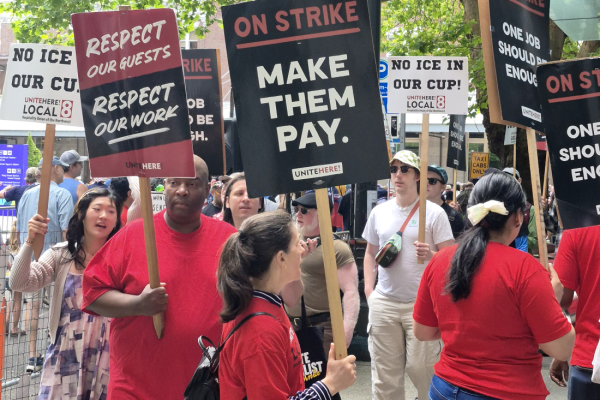
Opposition to the Albanese government’s attack on the democratic right of building unionists to elect their own officials is deepening. In August, the Labor government placed the entire construction division of the union into administration for five years, ignoring procedural fairness. Allegations were raised against a handful of elected officials, yet the entire union has come under attack. Two hundred and seventy officials have been removed and banned from working for another union — they heard they had been sacked through the media!
The Construction, Forestry and Maritime Employees Union (CFMEU) and its allies in the Building Industry Group (BIG) of unions are fighting back. Tens of thousands of building workers walked off the job for national mass rallies on 27 August. They were joined in huge numbers by members of the Electrical Trades Union (ETU), Australian Manufacturing Workers Union, maritime and plumbing unionists and hundreds of rank-and-filers from right across the union movement. These marches were led by rank-and-file CFMEU women.
Next up were mass meetings of delegates from the BIG unions, with 800 attending the Melbourne meeting to launch the “Line in The Sand” campaign with its focus on enforcing enterprise agreements.
As part of this campaign, workers again shut down building sites on 17 and 18 September in Brisbane, Sydney and Melbourne for mass protests. More than 60,000 assembled outside Victorian Trades Hall before blocking the streets of Melbourne, demanding that their elected officials be reinstated and Labor’s new anti-union law be withdrawn. Rally MC, Troy Gray from the ETU, said if conditions were attacked, the next stoppage would be 72 hours. “We put the industry on notice,” he declared. Workers roared their approval, determined to draw a line in the sand to defend conditions. The will to fight is clear.
Meanwhile the bosses in the industry, represented by the Master Builders Association, are applauding the bipartisan support for the attack on the CFMEU. They are not hiding their agenda, which has nothing to do with bikies on site or cleaning up the industry. There is an orchestrated campaign to remove recognition of delegates. Employers want to destroy the effectiveness of the CFMEU, a militant union that delivers good pay for members, prioritises safety and ensures all workers doing the one job receive the same pay and conditions.
Swelling solidarity. The Bendigo Trades Hall Council was quick off the mark with a resolution to stand with the CFMEU. It got to the essence, declaring “we believe that all unions have the right to determine their own affairs through the democratic control of their membership.”
RTBU members at the first mass rally in Melbourne to oppose state interference in the CFMEU. Photo by Alison Thorne.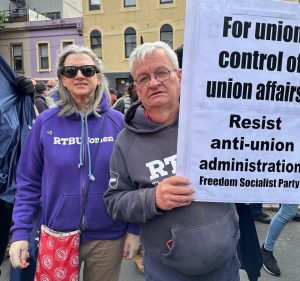
The strongest support for the CFMEU has come from the BIG unions, which have mobilised members in force to support the campaign. The South Australian branch of the Communication, Electrical and Plumbing Union (CEPU) responded to the attack on the CFMEU by disaffiliating from the Australian Labor Party (ALP). Then the National Council of the CEPU decided to disaffiliate from the Australian Council of Trade Unions over its active support for the CFMEU administration, arguing that this will open the path for government to take on other unions.
Members of the Maritime Union of Australia (MUA) at Hutchinson Ports passed a strong motion of solidarity. This was carried unanimously on all three shifts.
Another blue collar union backing the CFMEU is the Rail, Tram and Bus Union, which has organised members off shift to support the mass rallies. In a statement, Vik Sharma, the Victorian State Secretary, argued, “placed into administration on the back of media reports making allegations against a handful of people that have not yet been tested in the courts or even investigated by any other relevant regulatory bodies, the rest of the union and its members are being made to suffer weakened representation for the next three to five years.” He concludes that “this is an attack on all of us. As a fighting union who won’t kowtow to the wishes of governments and big corporates, we have a duty to stand on the right side of history and challenge the approach taken by the government.”
Another union to issue a solidarity statement is the Retail and Fast Food Workers Union. This union formed to challenge the SDA — a conservative retail union that is in the bosses’ pocket. Its statement highlights that the only sort of unions that the government ultimately wants are the tame cat variety.
While some union officials have been quick to recognise the dangers of the attack for all workers, in other industries it is rank-and-file unionists organising from the ground up. A strong resolution by the National Council of the National Tertiary Education Union (NTEU) supporting a return to democratic processes in the CFMEU was the result of a grassroots groundswell in workplaces. The NTEU branches at the University of New South Wales and Sydney, Monash and Latrobe Universities all passed motions of support. Hundreds of NTEU members signed an open letter to the union executive demanding their union back the CFMEU.
Teacher unionists used a similar tactic with rank-and-file members of the Australian Education Union, sending an open letter in support of the CFMEU to the national executive. The Queensland Teachers Union has passed a solidarity motion.
There is a similar pattern of rank-and-file organising in the Australian Services Union, with unionists at a number of workplaces, including Melbourne Community Legal, North Richmond Community Health, Inner Melbourne Community Legal and Brotherhood of St Lawrence, passing strong solidarity motions.
Rank-and-filers in the Community and Public Sector Union (CPSU) have also been building solidarity with the CFMEU. Members in Brisbane marched with a banner proclaiming that CPSU members stand with the CFMEU. The rank-and-file caucus, Democracy For CPSU, declared that with its attack on the CFMEU, the Albanese government is setting a terrible precedent. Caucus convenor Chris Warren said, “We’ve got to challenge the idea that the labour movement broadly supports the move against the CMFEU, save for a few blue-collar unions. There are many rank-and-file unionists, including in the CPSU, who are really alarmed and hold grave concerns.”
Fighting to win. A real strength of the CFMEU is the union’s active membership and its network of workplace delegates. Members understand the necessity of sticking together to fight for safe workplaces and decent pay and conditions. While it is true that the administrator wields immense power and controls all the resources of the union, what the administrator does not control is the hearts, minds and loyalty of the CFMEU membership. What’s needed is the formation of democratic rank-and-file committees in every workplace that maintain the tradition of walking off the job when necessary in defiance of industrial relations laws.
CPSU members rally in solidarity with the CFMEU in Brisbane. Photo courtesy Democracy 4 CPSU Caucus.
Sacked CFMEU leaders are mounting a High Court challenge, lodged on 4 September and supported by the Your Union Your Choice campaign. This challenge is being funded by a number of unions, amongst them the MUA, which explained, “our support for this legal campaign is not just to restore the rights and protections of Construction Division members but to hold the line against future attacks using similar legislation on other Australian workers.” The ETU is withholding $1 million that it would have donated to the ALP and using it to fund the High Court challenge instead. Court cases are slow and costly. On its own, this High Court challenge cannot beat back the serious assault on the CFMEU.
A meeting of the National Building Industry Group of Unions, which comprises 23 union leaders representing over 250,000 workers, convened on 16 October. It resolved to hold a Trade Unions for Democracy Summit on December 9. The key purpose of the summit is to protect union democracy and advance militant trade unionism. Creating a new union body to advocate for workers is on the agenda. The summit will also discuss political campaigning and funding union-aligned electoral candidates.
A welcome decoupling between sections of the trade union movement and the ALP is unfolding. Union officials have for far too long been tied to the Labor Party — a party which administers capitalism and fails to deliver for workers. Now, with this very party leading an assault on the trade union movement itself, it is time for unions to back candidates that genuinely fight for the needs of working people. Serious union backing for anti-capitalist candidates that advocate socialist solutions would be a game changer.
Alison Thorne is a member of the Democracy For CPSU caucus. Contact her at alison.thorne@ozemail.com.au.