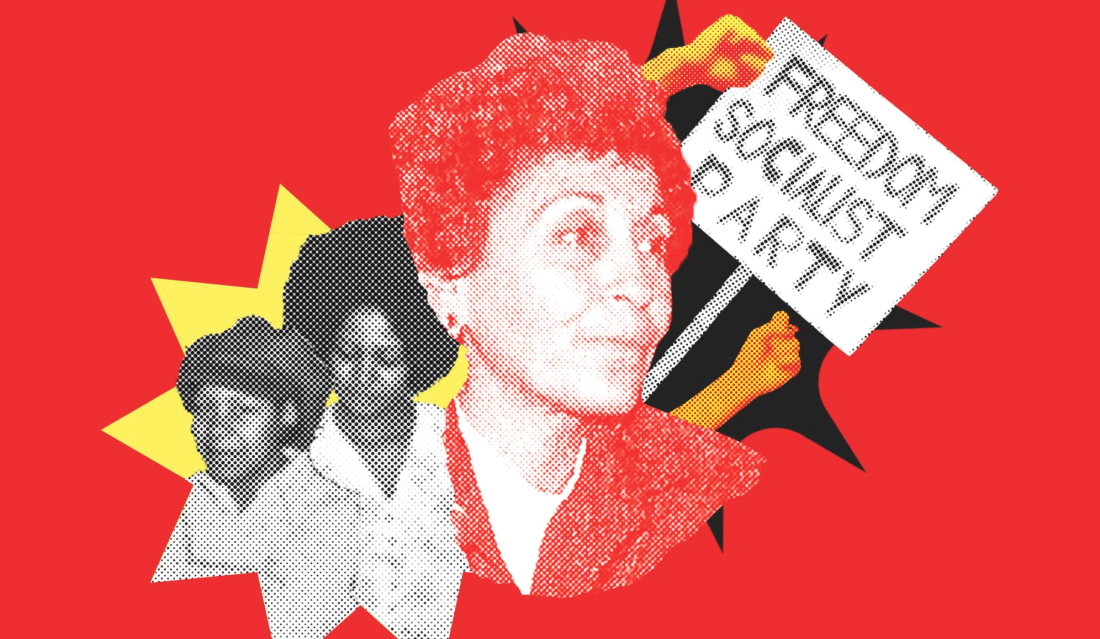
An award-winning French author, seeking an antidote to these dark political times, looked for inspiration from rebels who lived with hope and principle — and found U.S. socialist feminist leader Clara Fraser!
In one of four essays in the series “The Thread of Equality,” Joseph Andras brought the founder of the Freedom Socialist Party and Radical Women to the attention of French readers in the publication Contretemps in May 2026. Merci beaucoup, camarade!
In correspondence with the Freedom Socialist, Andras said he discovered Fraser by chance through a social media post that put forward “her call to bring all emancipatory struggles together under the banner of socialism. … I was struck by her understanding of socialism as a struggle for beauty and for life (rather than simply a struggle for structural and material change).”
From there, he delved into Fraser’s book Revolution, She Wrote. The result is a wide-ranging “ideological biography.”
Andras identifies socialist feminism as one of Fraser’s “most significant contributions to the cause of equality” and praises her fight for “genuinely socialist socialism” that rejects sexism on the Left. He cites her contention that feminism is both independent of and intertwined with the class struggle and that “it is essential never to work outside of this tension — just as with the anti-racist struggle.”
The writer observes approvingly that Fraser was no exalter of identity politics whether of women, Jews, African Americans or others. Class is the ultimate unifier. He summarizes: “The people are heterogeneous. … The only way to unite them without crushing anyone … is to promote a ‘theory of multiply oppressed subjects’ under the banner of international socialism.”
Fraser’s vision of a global uprising of women is affirmed by Andras, who states that “the world has been experiencing the fourth wave of feminism.” He credits the Kurdish call for “women’s revolution” with placing les femmes at “the heart of every new revolutionary process.”
A comradely debate
Andras disagrees with Fraser’s support for Russian revolutionary Leon Trotsky. He respects Trotsky’s opposition to Stalinist totalitarianism, but he charges the Bolsheviks, the party that led the 1917 uprising, with “bureaucratic and authoritarian tendencies.” In a frequent anarchist criticism, he expresses horror at Trotsky’s handling of an anti-Bolshevik uprising at the Kronstadt naval base in 1921.
One can imagine a discussion between Andras and Fraser at her dinner table in Seattle, the nexus of much of her political organizing.
“Joseph,” she might say, with a Manhattan in her hand and eyes fixed on his. “Pacifism could not save a workers’ state born during WWI, besieged on all sides by civil war and hostile foreign intervention. Trotsky was the head of the Red Army. The Kronstadt sailors were heavily armed and rejected attempts at negotiation. This was a period when all questions were decided militarily. What did you expect would happen?”
Their lively conversation would continue into the wee hours and also encompass the role of radical artists, feminism and queer rights, uprisings in France, the global fight against fascism, and much more.
A dignified life for all earth’s creatures
Fraser and Andras would agree that socialism is urgently needed. As he asserts, “It is irreplaceable if we aspire to put an end to the barbarity that reigns everywhere.” And to this, she would say, “Right on, brother!”