
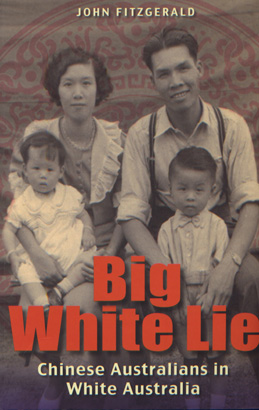
Big White Lie: Chinese Australians in Australia, published by the University of New
South Wales Press, is a fascinating book. It tells the story of Chinese people who
migrated to Australia before federation in 1901. Attracted by the gold rushes, these
Australian residents and their descendents continued to live, work and struggle in
Australia after the passage of the Immigration Restriction Act in 1901, which formalised
the White Australia policy.
Author and historian, John Fitzgerald, recollects being challenged by a fellow student
for studying Chinese and Greek when “there was so much to learn about Australia.” Big White Lie, his first book of Australian history, draws extensively on Chinese language
sources and this is its great strength. The resulting book is rich with detail, and we learn
so much about Australia as a result.
More than 500,000 living Australians claim Chinese ancestry. Fitzgerald characterises
this as “a living heritage that no museum can possibly capture.” TV chef and
restauranteur, Kylie Kwong, is one of 800 descendents of a Chinese Australian from
Darwin. Jeff Fatt, the purple Wiggle from the children’s super group, also has a
long Chinese Australian heritage as does Indigenous athlete, Kathy Freeman, who
acknowledged this when the 2008 Olympics were awarded to Beijing. World-renowned
guitarist, John Williams, is a grandchild of Melbourne barrister William Ah Ket, who
fought gallantly against discriminatory immigration restrictions in Victoria at the time of
federation.
Racism cannot be reconstructed. Fitzgerald sees this work as a contribution to
Australia’s “history wars,” — the reactionary campaign by the right wing to revise
Australia’s history so that it suited the world view of the white establishment. Defeated
conservative Prime Minister John Howard was a particularly vociferous participant
in this campaign. Along with Ron Brunton and Keith Windschuttle, who describe
themselves as historians, he advocated a view of history that is deeply racist and pro-
colonialist. The political objective of the campaign was to deny that the country was
founded on land theft, racism and sexism. The strategy used by Howard and his cheer
squad was to drown out the voices of Indigenous Australians, workers, women, gays and
lesbians, immigrants and Chinese Australians in a series of “Big Lies.” To me, “Big Lie”
means the tactic of countering facts with plausible untruths, then repeating these so often
and so loudly that they become the “truth” — at least as far as public debate is concerned.
Fitzgerald systematically demolishes the Big Lie that Chinese Australians were different
from other Australians: “servile, hierarchical, secretive and sinister.” In particular, he
debunks those trying to “restore the reputation” of the White Australia policy with
assertions that Chinese people were not excluded from Australia for racist reasons but
“because their habits, instincts and culture were incompatible with Australian values:
mateship, democracy and a fair-go.” This is the same bigotry used by the former Howard
government as justification for the introduction of its discriminatory Citizenship Test and
its ludicrous “Australian Values Statement.”
The book is full of stories about Chinese Australians who were great modernisers,
made wonderful community contributions or were radicals. In one example, Fitzgerald
documents a speaking tour by a remarkable young man, Liang Qichao. Liang spent six
months in Australia and was “ a brilliant champion of civic equality, gender equality,
class equality, racial equality and national equality.” He arrived in Fremantle on the
eve of federation, speaking to packed meetings in cities and towns across the continent.
Liang and his audiences embraced liberty, equality and fraternity, demonstrating that
“hierarchal ethics were the ethics of empires.”
Upheavals in the home country. A recurring theme is how political developments
in China shaped the activities of the community in Australia. Fitzgerald assumes that
readers have a considerable knowledge of unfolding historical events in both China and
Australia. A chronology, or even a short overview, would help to place the stories in
context.
The first half of the 20th century was a period of upheaval in China. The Chinese
Australian community was a part of this. In 1911, a democratic revolution led by Sun
Yat-sen overthrew the Manchu Dynasty which had ruled China since 1644. A second,
more radical, revolution occurred in 1925-27. This revolution was crushed at the hands
of Chiang Kai-shek who represented China’s ruling class. The third Chinese revolution
culminated in 1949, when the Chinese Red Army led by Mao Zedong overthrew the
Chiang regime.
Political connections. A significant section of the book looks at the influence of the
Chiang Kai-shek’s Kuomintang (KMT) in Australia. As a Trotskyist, I found this section
fascinating. The defeat of the 1925-27 revolution was both tragic and avoidable. In this
period, the Soviet Union was isolated, and this increased the influence of Soviet leader,
Josef Stalin. Stalin’s bureaucracy imposed a seriously flawed political policy on the
Chinese Communist Party (CCP). Under the banner of a “bloc of four classes,” Stalin
demanded that the CCP enter, support and subordinate itself to the leadership of the
nationalist KMT.
In the epilogue to his 1929 work, Permanent Revolution, Trotsky sharply criticised those
Marxists who thought it “possible to defend the keeping of the Communists in the cage of
the Kuomintang!”
The KMT was indeed a restrictive cage! An uprising was sparked by a 1925 protest in
Shanghai. Thousands of workers and students protested imperialist domination. Seven
were killed after being fired on by British police. Workers responded with a general
strike and mass demonstrations. But their “allies” in the KMT leadership saw their class
rule threatened. Chiang carried out a bloodbath against the workers’ movement in April
1927 which had been left disarmed — politically and militarily — thanks to the CCP’s
embrace of Stalin’s disastrous policy.
Fitzgerald details both political solidarity and fundraising activities organised by the
Australasian KMT and compares this with declining support from KMT branches in
other parts of the world, particularly the U.S. In 1923 the KMT was re-organised on
a worldwide scale and this, according to Fitzgerald, is when the Australasian section
grew in size and importance. There was a shift from fundraising activities to political
mobilising as Chinese workers, influenced by the CCP, flooded in. Fitzgerald argues
that “the emergence of ‘Red’ Canton’” was greeted warmly in the Sydney-based
KMT headquarters. “By the start of 1926 the party’s global overseas branch network
shed three-quarters of its membership.” In contrast, “the Australasian regional branch
expanded over the same period, making up almost one-seventh of the party’s entire
international membership.”
In 1925, the Australasian KMT decided to focus on recruiting Chinese merchant
mariners, particularly those working in the Pacific and on the Australia to Hong Kong
route. Fitzgerald reports that, “within a few years of the decision the Australasian branch
network had established 15 sub branches on mercantile shipping, nine on ships operating
out of Sydney, five on ships operating out of Perth and one on a vessel operating from
Auckland.” By 1927 around one in six Australasian members of the KMT were maritime
crewmembers.
Readers also find out about Sam Wong, a Sydney leader of the KMT, who was
passionate about workers’ rights. Wong was elected deputy head of the NSW branch
of the KMT and had a passion and talent for building strong links with the broader
trade union movement. In 1920, he organised a delegation from the Sydney Trades Hall
Council to attend the inaugural KMT conference and speak about socialism.
A class divided community. Of course the Chinese Australian community was
divided by class difference. However, the depth of anti-Chinese racism had impact
on the Chinese bourgeoisie who often combined with working class members of the
community to mobilise against the institutionalised injustice. As well as the stories about
the struggles of Sam Wong, Liang Qichao and the KMT seafarers, Fitzgerald describes
the contributions of the Chinese bourgeoisie who built businesses and chambers of
commerce.
A whole chapter is dedicated to “entrepreneurialism,” and those of us who are 21st
century customer service workers can “thank” Chinese Australians who set up several
huge department stores on Nanking Road in Shanghai and who, according to Fitzgerald,
invented the modern customer service industry as we know it! These buildings are
preserved today as heritage sites that are a monument to the entrepreneurialism of
overseas Chinese.
When the KMT turned on its proletarian CCP elements, it became clear that Wong and
the shop owners on Nanking Road were on a different side. Trotsky warned: “whoever
puts forward the bare formula” that the workers should subordinate themselves to the
bourgeoisie “is shamefully deceiving the workers of the East and is preparing new
catastrophes.”
Worth reading. While Fitzgerald lines up on the progressive side within the history
wars, he confirms that all history has a perspective. He correctly argues that the Chinese
Communist Party was able to “harness mass discontent over racism, foreign humiliation
and colonial infringements in China’s territory” to make a revolution in 1949. But he also
clearly considers that the revolution went too far. In fact, many of his assumptions are
based upon his sympathy with liberal republicanism and his hostility to Marxism.
Big White Lie is both useful and limited. Its significant value is that the contributions of
Chinese Australians — living in the repressive White Australia era — are documented
and celebrated and that they speak in their own voice. Its limitations are an assumed
understanding of the big picture context and an analysis that restricts itself to presenting
Chinese Australians as a group that both survived and resisted institutionalised racism.
As I turned the pages, there were so many stories that made me cheer. I appreciated
reading about Vivian Chow, a student at Lismore High School, who was proud of his
Chinese and Australian heritage. When a teacher took him aside and told him to stop
“harping on” about his Chinese ancestry and challenged him to explain what China could
mean to him, young Vivian replied: “you were born in Australia, so was I. Your father
came to this country as a pioneer, likewise my father. May I give the retort, courteous sir,
and say to you: ‘why are you so proud of being Irish? Why is it that you storm and agitate
about home rule in Ireland, and what does Ireland mean to you anyway?’”






