
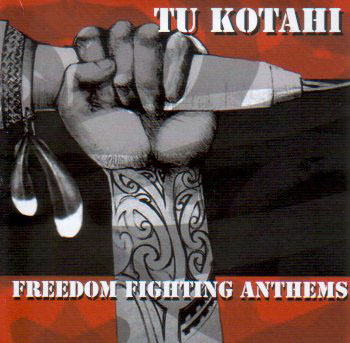
Tu Kotahi Freedom Fighting Anthems is an eclectic mix of music from Aotearoa. The
double CD is a solidarity project to raise money for New Zealand activists targeted last
year in a series of politically motivated raids (see “Dateline Aotearoa — Communities
unite against misuse of terror laws Union organiser, Louisa Jones, draws lessons from the
struggle” Freedom Socialist Bulletin # 38).
On October 15, police carried out dawn raids across the country. Claiming they were in
response to “concrete terrorist threats,” police have failed to produce a shred of evidence.
Seventeen Maori, anarchist, environmental and anti-war activists were arrested and
threatened with charges under the Terrorism Suppression Act. However, after a massive
protest campaign, the Solicitor-General denied the police permission to proceed and, after
four weeks in jail, everyone was released on bail.
Further arrests followed in 2008 and, currently, 20 people still face charges under the
Arms Act and a trial that could take several years. Although out of jail, they have strict
bail conditions that deny them the freedoms of movement and association.
While defeating the use of terror laws was a victory, solidarity is urgently needed for the
battle ahead.
Music from the movements. Tu Kotahi is a beautifully organised compilation that
features a lucky dip of big names from the music scene and movement performers. The
first CD is “Freedom.” Its theme is women with attitude!
The collection opens with “Rise Up” a soaring unaccompanied piece by Kiritapu Allan
who defiantly declares, “we are making a stand” and hisses “we are sick of being your
slaves and your whores.” Allan, an activist from the Ngati Ranginui people, is in her
early 20s. Her voice is a haunting and powerful call to action.
“Freedom Fighters” is performed by rappers Miss bMe, Miss Ginger and Rose Simpson.
“Drums of War,” by Flowsion, keeps up the dance beat while critiquing the system. We
hear about Maori “facing hard times locked up in prison” and who are “trapped in the
system.”
“Philistines” by Sheba Williams is the stand-out track on Tu Kotahi. A video clip
of the charismatic Williams performing “Philistines” is on her My Space page. She
has the same kind of ‘don’t mess with this big Black woman’ persona popularised by
Grace Jones. She wrote the song to critique the growth of materialism, describing how
missionaries told Maori “to get down on their knees and pray.” But, although claiming to
be there to “save” people, “it was all a con” because “when they opened their eyes they
found all their land was gone.”
The next track, “Danger,” is by Verse Two, a soul/hip-hop band. Fronted by Ladi6, the
women sing about the “nation’s woes” and call for solidarity through “helping yourself
by helping others.” The track is pure funk interwoven by a magical flute melody.
Another powerful track on the first CD is “Black and Gold” by Olmecha Supreme, an
indie band which describes itself as an Afro futuristic roots group. A clip of this track
is also available on the internet. The anti-war message hits you and builds to a musical
crescendo as we hear about wars for resources: “and now we kill for black and gold.”
Upper Hutt Posse also features on the CD. Fronted by the legendary Dean Hapeta,
they’ve been a part of Maori popular culture since 1985, when they blasted onto the
scene as a reggae band. The Posse have been fighting injustice through music ever
since. Hapeta is an out and proud radical whose key message to youth is unity. He sees
tribalism as a curse and is clear that his message is not anti-white, but directed at what he
sees as “white institutions” that victimise white youth as well as Maori and Pacific Island
youth.
The Posse’s contribution to Tu Kotahi is “Hold I True.” The film clip on You Tube is
rich with internationalism as the band uses images of resistance from around the world.
The harmonies are exquisite and the words defiant: “we’re protestors, we’re resisters”
and “yes, resist, pump that fist, for true justice we insist.”
There’s something for every musical taste. The closing track on “Freedom” is “Di Grine
Kuzine” by the Klezmer Rebs. Sung in Yiddish, it is an anti-sweatshop song dedicated
to the singer’s grandmother, an organiser with the International Ladies Garment Workers
Union. The Rebs are an eight-piece band that plays klezmer music, a style of world music
born out of the Yiddish/Jewish culture of Eastern Europe.
The second CD is “Fighters.” It has a different musical feel. About half is comprised of
tracks in the punk and thrash music style. While not near the top of my list of favourite
musical genres, punk fans will appreciate this portion of the collection. Dead Vicious
performs “Capitalist Cheerleaders (Fat Gits in Suits).” It is a searing critique of the
capitalist system and the repressive apparatus that makes sure “profit comes first and our
people come last.” We hear “there’s not much freedom in the free market” and “they pay
the cops to keep us in line.” This track definitely deserves its spot on Tu Kotahi.
Punchbowl is a band led by a female vocalist. In “A man in uniform can’t resist” she
demands, “leave your filthy paws off my filthy drawers.”
There’s also some more reggae inspired tracks. “Calling,” by the Cornerstone Roots, has an infectious beat as it
demolishes the premise behind the “war on terror.” Religion also gets more of a serve.
Like Olmecha Supreme, Homefire Burning in “Watching You” sing about how religion
is used to peddle imperialist wars for gold and oil.
“Snakes and Scorpions,” by the Managers, stands out musically for its great saxophone.
“Snakes and scorpions in our beehive” slams politicians. The distinctive parliament
building in Wellington is called The Beehive because of its shape. This infectious song
also calls to listeners to be active: “don’t sweep things under the carpet” and “don’t sit on
the fence — stand-up!”
I appreciate the number of languages on this CD. As well as Yiddish and the many multi-
lingual tracks in English and Maori, Koile sings in the language of the Tokelau Islands.
“Te Hua” has both sensational saxophone and some creative use of traditional Tokelauan
chants. Koile is a 12-piece roots band that plays its own brand of Pacifica reggae.
The Indigenous experience. For someone deeply involved in the struggle to win
justice for Indigenous Australians, this compilation was a reminder of the international
commonality of the Indigenous experience — land theft, missionaries, cultural
destruction and deaths in custody.
“Steven Wallace, Waita Tangi” is a combination of powerful performance poetry,
hip-hop and ballad, performed by Anatoni Te Maioha. It is the story of Steven James
Wallace, a 23 year-old Maori university student, who was killed by police in 2000.
Wallace was breaking windows when three police confronted him. Although police had
a range of options open to them, they fatally shot Wallace, who was unarmed. Of course,
the police were not held to account! In this piece we hear how “the killer goes walking”
and how he took a “taxpayer-funded redundancy” and headed to the Gold Coast. The
irony is that Senior Sergeant Chris Hurley, responsible for the death of Mulrunji in the
Palm Island watch house, is also living on the Gold Coast.
Tame Iti, Tuhoe leader and one of those arrested in 2007, opens “Fighters” with a
powerful performance piece that tells the story of the raid. And in a later piece he
forcefully asserts, “I am not a terrorist, I am a Tuhoe.” These two tracks are like a
punch in the gut, reminding the listener exactly why this CD was made and why it
deserves widespread distribution. For information about ordering Cds, go to http://
freedomfighterscd.org.nz/






