“Never again!” Since the defeat of Nazism in 1945, it has been established mainstream political thought both inside Germany and internationally that there could never be a repeat of what happened back then.
And yet with recent elections in parts of Germany, the AfD, a party described as “far-right extremist” by Germany’s own intelligence services, won the most seats of any party in two states, and gained seats in Berlin.
The AfD’s platform is a toxic brew of reaction: anti-immigrant, Islamophopic, queerphobic, and anti-European Union (called “Euroskepticism”). Ominously, it echoes the fascist call for a return to “the traditional family.” In other words, intolerant, chauvinist, bigoted and dangerous.
How, in social democratic Germany with its 80 million people, massive economy and relatively high standard of living, did this come to pass?
Germany has attempted to legislate away the lingering elements of its fascist past, but recent events show this is not possible. It is a failed strategy of liberalism and the deal-making politics of social democracy.
To be sure, it is no accident that the right wing has been most successful in states which once belonged to East Germany (GDR), including Saxony-Anhalt and Mecklenburg.
Those regions are still feeling the shock effects of unification with capitalist West Germany which began in 1990. Previously, industry was nationalized there as in the USSR. Millions of people lost guaranteed housing and employment, and a stable social system was uprooted. Depopulation and loss of industry created poverty, making ideal conditions for disaffected youth to reject everything associated with the old regime, and to turn to political extremism.
The recent electoral results are directly related to that history. It is worth pointing out that the world’s first trillionaire is seeking to influence electoral outcomes not only here in the U.S., but in other countries including Germany. Elon Musk publicly endorsed the AfD, supported one of its prominent leaders, Alice Weidel, and promoted its views on his social media platform X. Additionally, Musk has spread disinformation that attempts to demonize immigrants and weaken public trust in the election process.
A tenuous stability
Up to now, the center-left and center-right parties which account for the majority of Germany’s coalition government have agreed to a “firewall,” refusing to work with the far-right. But now that the AfD has won so many seats, that tactic might not hold.
In the rural federal state of Saxony-Anhalt (population 2.1 million) the AfD won the election with almost 44% of the vote, and in Mecklenburg-Western Pomerania (1.5 million people) it won with 38%.
In Berlin (population almost 4 million), Die Linke, a left social democratic party, won with 25.7% of the vote. It is significant that their lead candidate is a woman of Turkish descent, who stands to become the next mayor of that culturally diverse and liberal city. However, with the gains simultaneously made in Berlin by the AfD (29 of 153 seats), it remains to be seen what parties will come together in order to be able to govern and whether the firewall will be viable.
A system in crisis
Add to this precarious situation the fact that the more established and centrist “popular parties” CDU (Christian Democratic Union) and SPD (Social Democratic Party) lost their traditional majorities in the three states. Contemplating the possibility of losing his own position, Chancellor Merz, who heads the CDU, called the recent losses a “disaster.”
As Russian revolutionary Karl Radek stated, when social conditions reach a breaking point, “Fascism is the iron hoop that holds together the collapsing barrel of capitalism” in order to break the ability of the working class to resist.
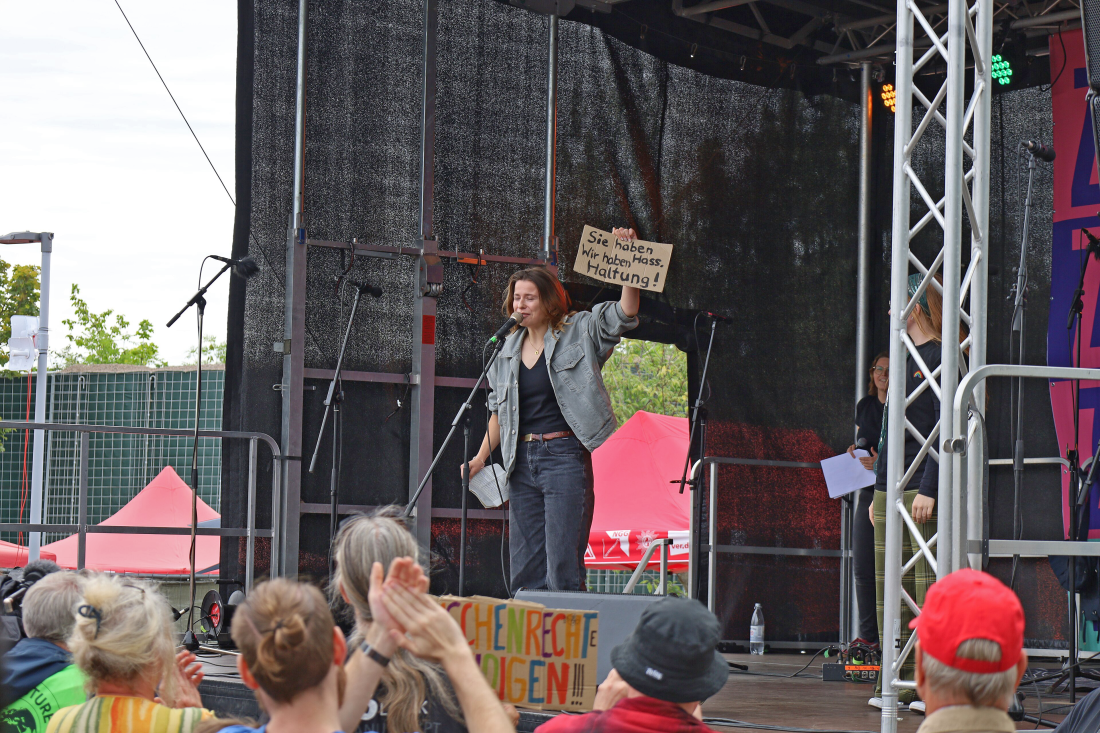
But protest against what the right wing represents is exploding.
As in France, students in Germany are now organizing to fight cuts to education and social services, and increases in military spending, and they reject scapegoating of immigrants and the most vulnerable. Organized by the youth-led initiative known as Gen Z Regelt (Gen Z takes charge), 120,000 people across 30 cities hit the streets on Oct. 31 to demand change.
In Germany and around the world, the solution lies in building anti-capitalist movements with the power to push this rotten system off the stage of history once and for all.
Send feedback on this article to FSnews@socialism.com.