
On 25 November 2008, Deputy Prime Minister Julia Gillard grandly told Parliament that the government’s Fair Work Bill “takes the Australian value of the fair go and builds around it a new workplace relations system ready to meet the needs of the nation in the 21st century.” ACTU President Sharan Burrow echoed Gillard’s enthusiasm, declaring, “the Fair Work Bill turns the tide after a decade of attacks by the former Coalition government and marks an historic turning point in restoring workers’ rights.” But despite the hype, much of John Howard’s hated WorkChoices regime will remain intact.
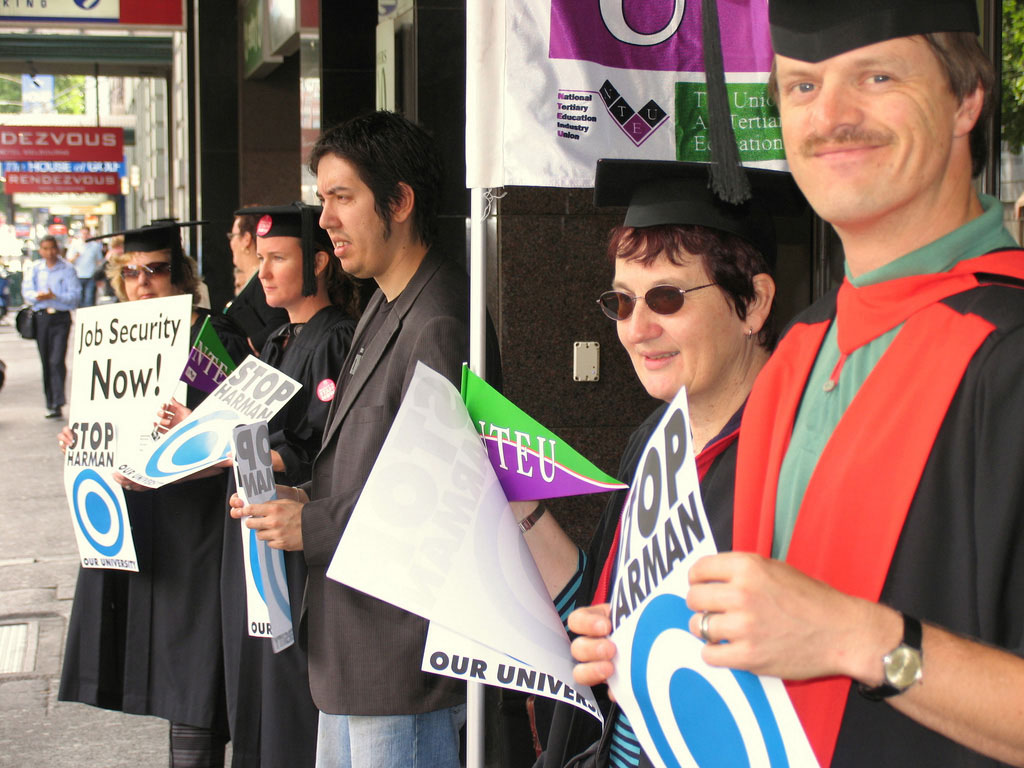
National Tertiary Education Union members at Victoria University stopped work on 8 December.
Photo by NTEU Vic.
Breaking the silence. One group of workers sure to be disappointed is the Asian Women at Work Action Group. The Sydney-based group, which has 150 predominantly Chinese and Vietnamese members, campaigned vigorously with the goal of influencing the shape of the legislation. Last April, they launched Cries from the Workplace which tells 20 women’s experiences of working in the food processing, textile and other manufacturing industries. They say, “This is about more than just ‘getting rid of WorkChoices.’ The government says they will build a new industrial relations system. We want to make sure the new industrial relations system is truly able to protect migrant women workers like us.”
The group used their own experiences to highlight what is needed. They sent delegations to Canberra to tell their stories directly to Members of Parliament. Their eight representatives describe a meeting with Julia Gillard’s adviser as the one “requiring the hardest work!” They “sought to convince her of the need for more extensive legal protections to address the poor wages and conditions of migrant women workers.” The delegates were scathing of suggestions from the Minister’s office that “small business employers were not very well organised or capable of writing so the government didn’t want to burden them with having to write a warning letter, instead making a verbal warning sufficient.”
The group also prepared submissions and appeared three times before the Industrial Relations Commission’s Award Modernisation hearings. Angela Zhang and Hui Juan Liu spoke out about bullying and harassment in many workplaces. They also described how large numbers of workers were underpaid and denied minimum conditions. While the women want a strong, proactive inspectorate to ensure that employers follow the law, they argue that the best protection is to enhance the power of unions. Zhang stressed this to the IRC: “Before the election last year our Action Group met with one of Joe Hockey’s advisers to talk about WorkChoices and how it had caused so much hardship for migrant women workers. The adviser proudly talked of having increased the number of industrial relations inspectors to 300 to cover the whole of Australia. Our Action Group almost laughed at him. How can 300 inspectors cover all the workplaces in Australia? How can they possibly replace the enormous role that thousands of union organisers undertake, checking up on workplaces across Australia on a regular basis? Our members see the unions’ role in Australia as very important to protect them and support them.”
Workers didn’t vote for rollbacks! The Fair Work Bill imposes significant limitations on the ability of unions to organise. Organisers must have permits stating that they are “a fit and proper person” before they can enter a workplace and are required to give 24 hours’ notice. The boss will still be able to determine when and where the union official may meet with members. In my previous call centre workplace, once the union organiser had completed all the red tape to get in the door, the employer prevented meetings in the busy tea room, reducing access and visibility by confining the union organiser to an out-of-the-way office. Strike action is legal in very limited circumstances: to secure a new agreement and only after the previous one has expired. Unions must also conduct a secret ballot of members before a strike is legal. Solidarity and political strikes are banned, as is any strike action during the life of an agreement. The ability to impose hefty fines remains, and the government can block even “protected” industrial action if it considers the action to be causing “significant industrial harm to the employer” or “significant damage to the Australian economy.”
Many of the women who told their stories in Cries from the Workplace describe the vulnerability they feel, working in industries where jobs are disappearing. With the introduction of WorkChoices, employers openly used the threat of the sack to demand speed-ups, forced overtime and unsafe practices. The Fair Work Bill does not propose to fully restore unfair dismissal rights. It will enable those employed by companies with a workforce of less than 100 to claim unfair dismissal, but only after 12 months’ service. For those working for large employers, this right is available after six months. However, the new bill caps compensation, at six months wages, to a worker who proves unfair dismissal.
Organise! Julia Gillard states that with the passage of the Fair Work Bill, the government will have “delivered in full” on its promises to the electorate. But the blatant abuses the women so movingly expose in Cries from the Workplace will not magically disappear. Looking to the future, we’ll get the wages and working conditions that we have the collective strength to fight for and win.
The organising done by the Asian Women at Work Action Group will contribute to the collective strength of workers by empowering and educating its members and promoting the benefits of union membership.
Building democratic and inclusive unions prepared to defy the limitations imposed by the Fair Work Bill — whenever they have the collective strength to do so — is essential to defend and extend workers’ pay, conditions and public services in the tough times ahead.






